
The book ‘Gentlemen of Honour‘ (by Bernard Byrom) tells the fascinating story, most of it never told before, of the Robertson and Williamson families who owned both the Balgray estate in Dumfriesshire and Lawers estate near Comrie in Perthshire.
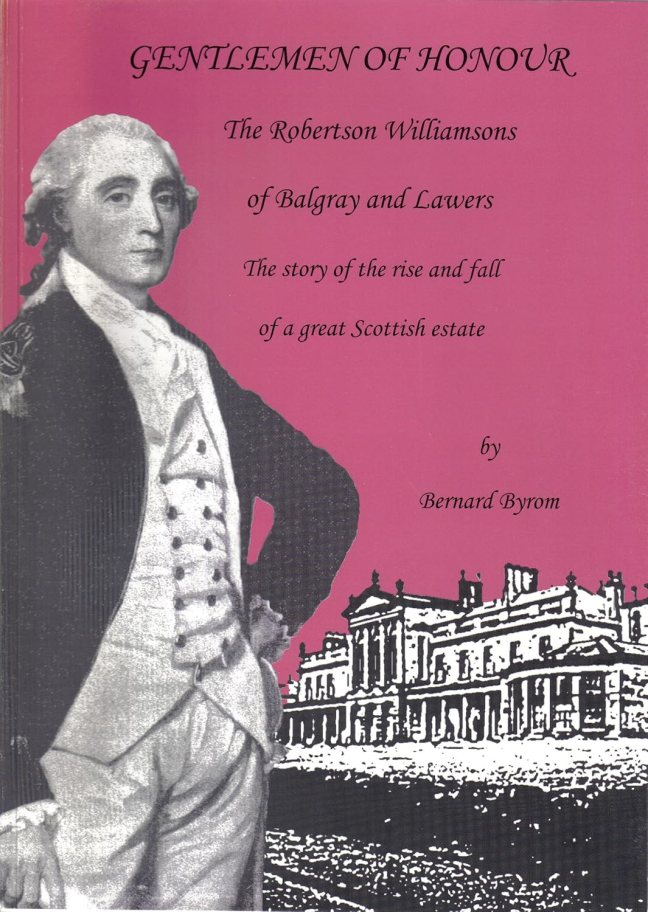
Their history begins in triumph in the eighteenth century and ends in tragedy with the break-up of the Lawers estate in the twentieth, and sheds new light on the well-known feud between Colonel Williamson and his only son Charles.
The story of the families begins at the time when General Archibald Robertson, a veteran of the American War of Independence, purchased the 35,000 acre Lawers estate in 1784 from the Campbells who had been driven from their home on Loch Tayside during the Marquis of Montrose’s uprising in 1645. After the General’s death the estate was inherited by his niece who married David Williamson, Lord Balgray, who was a respected judge of the Court of Session. David’s father Alexander had started out in life as an estate factor at Balgray in Dumfriesshire and rose to become Lord Hopetoun’s Private Secretary, spending most of his time working at the earl’s mansions at Hopetoun House near Edinburgh and at Moffat. On one occasion he crossed swords with the great Robert Burns over the dismissal of a Moffat schoolmaster for alleged cruelty to a pupil because it appears that the schoolmaster had literally tried to knock a modicum of education into a dimwitted boy!
David’s elder brother, Charles Williamson, led an exciting life and his activities ranged from being a British spy to developing much of New York State in the 1790s on behalf of the Pulteney Associated. He died of Yellow Fever on board a Royal Navy ship in 1804 whilst returning from a secret government mission to the West Indies.
Charles’s own son, Charles Alexander Williamson, lived somewhat in his father’s shadow but had ambitions of becoming a millionaire when gold was discovered in California in 1848. Unfortunately, he died of cholera at Fort Leavenworth whilst on his way out west to make his fortune. This left his 19-year-old son as heir to the Lawers estates.
This son was Colonel (as he became) David Robertson Williamson who was one of the most colourful characters that Perthshire has ever known. He married the Honourable Selina Maria Morgan who was a daughter of the first Baron Tredegar and from the time he inherited the Lawers estates in 1852 he devoted his life to managing his estates and fulfilling his responsibilities as one of the principal heritors of the Comrie area whilst simultaneously enjoying life as a daring horseman and foxhunter. The book also reveals, for the first time ever, the true reason why he was sent to prison in 1853 for assaulting the minister of Monzievaird church. Whilst the Colonel always had the Comrie villagers’ best interests at heart and tried to do what he thought was best for them over the years, it wasn’t always seen that way by the villagers themselves and his increasingly autocratic methods of running things weren’t always appreciated locally. Some of the frequent and amusing ‘spats’ between him and the villagers are described, along with the many benefits he brought to the area such as almost single-handedly getting the railway built from Crieff to Comrie in 1893.
The last part of the story deals with the bitter relationship between the Colonel and his only son Charles who he disowned for becoming a Roman Catholic priest and against whom he waged a vendetta that ended with the break-up of the estates in the twentieth century. Charles became dependant on the loyal support of his old schoolfriend Reginald Brett who, after he became the second Lord Esher, saved Charles on numerous occasions from mental and financial ruin. The book contains extracts from many of Lord Esher’s letters that not only show their close personal relationship but also demonstrate the lengths to which he went to protect Charles.
 The Lawers Experience
You must be logged in to post a comment.